
We're proud to be honouring the Accrington Pals at Padiham on Parade Sunday service this year. We wanted to share their moving story with you so you can join the memorial with us and join in the parade to acknowledge their sacrifice.
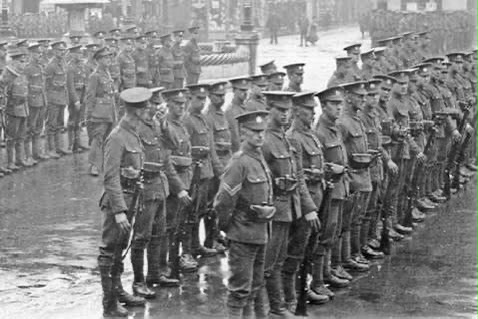
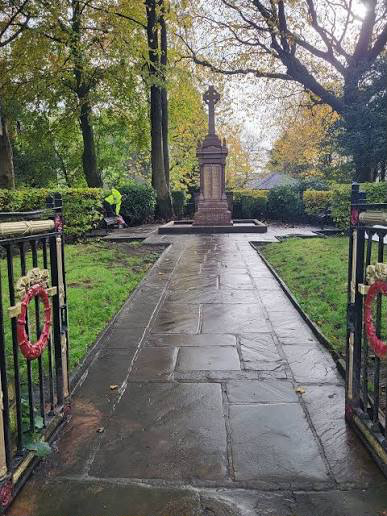
In September 1914, the start of the Great War, nearly eleven hundred men responded to the call for a volunteer Accrington battalion. Around half the battalion came from Accrington and district; most of the remainder were men from Blackburn, Burnley and Chorley. So were formed the 11th Service Battalion, East Lancashire Regiment the 'Accrington Pals'.
In the months that followed, the battalion trained in and around their home towns, until February 1915, they left for further training in North Wales, then in Staffordshire, Yorkshire and Wiltshire.
In December 1915, they moved again, this time to Egypt, but the danger there receded. So it was that in February 1916 - 110 years ago almost to the week, they received the order to go to France, to join the attack on the Somme which was planned for the Summer.
The plan was to use artillery bombardment to destroy the enemy lines before the attack. On Saturday 24th June, the men heard the bombardment start. From their camp, seven miles back from the German lines, the noise was deafening. Such was the ferocity of the barrage that it could be heard as far back as the South coast of England.
All week the bombardment continued. In early evening of Friday 30th June, the Accrington Pals left their camp for the march to their forward positions, with orders to take the German lines at Serre. The leading companies of the battalion reached the front trenches at 2.40 am on Saturday 1st July.
As the sun rose over the trenches that Saturday morning, the Accrington Pals, alongside tens of thousands of other British and French soldiers, listened as the artillery assault intensified to an astonishing level. In one hour, along the 14 mile front line, a quarter of a million shells were fired, and seventeen massive mines were detonated under German positions.
As they listened, both the soldiers in the trenches and those who had planned the attack believed that the massive artillery assault of the past week had cleared the German lines and the victory was assured.
At 7.20 am, over the sound of bombardment, which was still continuing, the Accrington Pals heard the first of the whistles being blown in their trenches. These whistles ordered the first wave of the Battalion over the top into no-man's land.
At 7.30 am, the guns fell silent. The bombardment was lifted, and the leading lines of the battalion heard the order to rise and walk towards the abandoned German lines. They expected no - or very little resistance. Instead, from the enemy trenches came a hail of machine gun fire. For in that fateful moment, at 7.30 am, it became clear to all that the bombardment had not done its job, and the German defences were very much present.
By 8.00 am, the battle for Serre was all but over. Out of 720 Accrington Pals who took part in the attack, 584 were killed, wounded or missing. They were among 57,470 British casualties on that one day.
What can anyone say, contemplating such a day as this?
The first word we wish to speak is sorrow.
Looking back, historians continue to wrestle with the historical significance of what turned out to be the overconfidence of that summer morning. Across our society, some struggle to understand; others feel that, across the century which has elapsed, they begin to do so.
Yet, two truths unite us all. We can stand as one in numbered horror at the scale of the loss of life. And we can stand shoulder to shoulder in remembering the lives of those who died that day. Lives taken by enemy fire given heroically for our nation.
When news of the devastating loss at Serre reached Accrington, the bell of Christ Church chimed all day.
In street after street, curtains were drawn. Throughout the next two months, the local newspaper, the Accrington Observer Times, carried photographs of those who had lost their lives, the wounded and the missing. Hardly a family was left untouched by grief, heart-break, and irreparable loss.
This year, over a century later, Padiham on Parade will remember the loss of so many lives of local men. We will remember too, the deep trauma experienced not only by the families of those who fell in battle but the whole community of Accrington and surrounding towns including Padiham. Telling the story of that day in July, 110 years ago, we recall in sorrow the ordeal which once marked the streets of our town.
The second word is surely heroism.
Brigadier-General Reese, recalling the actions of the Accrington Pals Battalion on the 1st July 1916, wrote this:
'The result of the shells, shrapnel, machine-gun and rifle fire was such that hardly any of our men reached the German front trenches. The lines which advanced in such admirable order, melted away under fire; yet not one man wavered, broke the ranks or attempted to go back. I have never seen, indeed could never have imagined such a magnificent display of gallantry, discipline and determination.'
Alongside the suffering and loss, we remember also the patriotism of those who answered the call of their country to serve in uniform - and the heroism of those who marched into battle that day.

Visit the Accrington Pals website
Jim Bates
 Highly respected, Mr Jim Bates, served on convoy escort duty with the Royal Navy during the infamous Artic Convoys, a perilous operation that saw him receive a commendation and medal from the Russian Navy. Jim also served in Operational Pedestal, the British plan to carry supplies to the island of Malta in 1942, for which he received recognition.
It was Winston Churchill's plan to save the besieged and heavily bombed island, and although the convoy suffered a heavy loss including an air craft carrier, it did manage to get through with vital supplies of fuel and war planes.
Jim received medals and other honours from the Maltese government over the last 20 years in gratitude for his and his comrades' service in protecting the island from the Germans and Italians.
Ted Davidson

Ted was presented with a French Legion d'Honneur medal. Rudolph Sourlard, from the French Consulate said: "It is an honour to give you this for your part in the liberation of France. France wants to thank you for the commitment you showed to our country during this terrible war. This is a message that we should not forget and we will never forget. May your bravery, commitment and dedication serve as an inspiration to others."